
Breaking News
Breaking: Charges Against Investigative Journalist Leroy Truth Fully Dismissed in Trenton Municipal Court — Another Major First Amendment Win
October 14, 2025 — In a dramatic courtroom turn today, the State’s prosecutor in Trenton Municipal Court formally admitted — on the record, not just in…


Trenton, N.J. — October 14, 2025 — In a dramatic courtroom turn today, the State’s prosecutor in Trenton Municipal Court formally admitted — on the record, not just in filings — that investigative journalist Leroy Truth holds constitutionally protected rights under the First Amendment for his speech and reporting.
Following that admission, the Trenton, New Jersey assistant prosecutor Cindy Liccardo moved to dismiss all charges previously brought against him by the New Jersey State Police.
The judge granted the motion, concluding that the State’s case could not survive the threshold protection afforded to press and speech activities.
This marks yet another legal vindication for Leroy Truth in his long-running and highly contentious confrontation with Union City Mayor and New Jersey State Senator Brian Stack, whose alleged use of state institutions to silence critics has drawn renewed scrutiny in light of today’s decision.
Background: The Senate Judiciary Hearing and Unlawful Arrest
A few months ago, the New Jersey Senate Judiciary Committee, Chaired by Senator Brian P. Stack, convened a hearing on a controversial bill approved by Senators Stack and Sarlo. Leroy Truth attended to deliver his public critique, calling both the Bill that was proposed as well as New Jersey state senator, head of the New Jersey state judiciary committee and Union City, New Jersey Mayor Brian Stack corrupt and warning that the bill would effectively shield corruption and political machines.
As he spoke, Truth accused Senator Stack of being corrupt and warned the legislation’s real aim was to immunize those in power.
According to multiple accounts, Senator Stack—outraged by the criticism—immediately directed state police to forcefully remove Leroy Truth from the hearing room. Numerous horses within the New Jersey state police alleged that senator in Mayor Brian Stack had already arranged New Jersey State police to forcefully remove Leroy Truth in the days proceed in the meeting in Stack’s latest desperate attempt to stop Leroy Truth from continuing to investigate and exposes over 5000 allegation corruption that Truth has received over last 22 months.
It’s also critically important to know that New Jersey Senator and Union City mayor Brian Stack has allegedly had Leroy Truth attacks for political violence over 45 times over the last 22 months in an attempt to get right through to stop investigating exposing alleged extreme corruption.
Stacks actions of course are unprecedented in US American history where no journalist has ever endured so many political violent attacks against him as he is exercising his first amendment rights as an independent investigative journalist reporting on his YouTube Channel and Facebook Page Leroy Truth Investigations.
In the ensuing confrontation, State Trooper Sergeant Christopher Anicito, as seen on video, shockingly AND illegally turned off Leroy Truth’s camera, interfering with his recording of the event and seizing control of the narrative. The forced removal and camera shutdown triggered a cascade of claims — including abuse of authority, excessive force, and blatant First Amendment violations.
Leroy Truth was injured by the New Jersey State police as they were violently removing him and immediately went to the emergency room for medical treatment.
The removal and camera shutdown were captured on video and widely circulated, fueling public outrage and sparking lawsuits. Truth has long maintained Stack weaponized his political influence and law enforcement machinery to silence dissent. Truth was later charged by NJ State Trooper Sgt Christopher Anicito, for Disorderly Conduct/ Improper Behavior under 2C:33-2A(1).
Courtroom Today: Prosecutor Concedes First Amendment Protections
In today’s hearing, the prosecutor twice conceded that Truth’s speech and press activities were constitutionally protected, essentially stripping away the State’s justification for pursuing the charges. With no credible basis to proceed, the State voluntarily moved to dismiss all counts — a rare instance where the government itself abandons its own case in open court.
Observers say this is not just a personal victory for Truth, but a wider affirmation of press freedoms against politically motivated prosecutions. The dismissal underscores that even powerful public officials like Stack and Sarlo cannot use state police or municipal courts as blunt instruments to silence critics.
First Amendment Caselaw: Right to Record Officials and Government Accountability
Though the U.S. Supreme Court has not yet squarely recognized a universal “right to record” government officials in all settings, the trend in multiple federal appellate courts has been to treat filming or recording public officials performing their duties in public as a First Amendment–protected activity.
A widely cited example is Glik v. Cunniffe (655 F.3d 78, 1st Cir. 2011), in which the court held that a private citizen had the right to videotape public officials in public spaces. The Glik court observed that recording public officials is “an exercise of First Amendment liberties” and that the constitutional protection is not limited to professional journalists.
Moreover, brief filed by the MFIA Clinic (Media Freedom and Information Access Clinic) refers to ongoing First Amendment litigation where Yale Law School’s clinic — which represents journalists, transparency advocates, and public-interest groups — has argued that turning off, deleting, or otherwise suppressing a person’s recording by a government actor (such as a police officer, state trooper, or public official) is itself a form of unconstitutional prior restraint and retaliation.
Turning off or confiscating a recording device is not “neutral conduct” — it’s content-based suppression.
This line of reasoning ties together multiple precedents:
Glik v. Cunniffe (1st Cir. 2011) — recording public officials is constitutionally protected.
Fields v. City of Philadelphia (3d Cir. 2017) — explicitly recognizes a citizen’s right to record police under the First Amendment.
Turner v. Driver (5th Cir. 2017) — extends the same protection, but notes officers may be immune if the right was not “clearly established” in their jurisdiction at the time.
Project Veritas Action Fund v. Rollins (1st Cir. 2020) — struck down a Massachusetts law prohibiting secret audio recording of public officials, reaffirming the strong protection of public recording activities.
Thus, the forced shutdown of Truth’s camera by Trooper Anicito arguably falls comfortably within the class of governmental action that courts have long guarded against.
Implications: Another Black Eye for Stack, But the Fight Continues
For Brian Stack and Senator Sarlo, today’s dismissal is more than a legal defeat — it is a public relations and constitutional rebuke. Stack’s alleged use of state police and prosecutorial machinery to retaliate against a journalist raises grave questions about the boundaries of political power and accountability in New Jersey.
Critics have long warned of the “weaponization of law-enforcement” — when officials under color of law use investigative or prosecutorial authority to target political opponents or critics. Today’s outcome bolsters the assertion that such tactics, if deployed, are vulnerable to judicial check.
That said, the fact that Truth had to litigate — repeatedly — to maintain his rights underscores an ongoing tension: accountability demands vigilance, resources, and legal fortitude. The victory today is significant, but it is not the final chapter.
In a comment Leroy Truth thanked his attorney Mario Blanch for helping get the charges dismissed as well as for asking the judge for the expedited expungement.
See the YouTube videos below for a recollection of the events that took place at the NJ State Senate Judiciary Committee.
Discover more from HUDTRUTH
Subscribe to get the latest posts sent to your email.
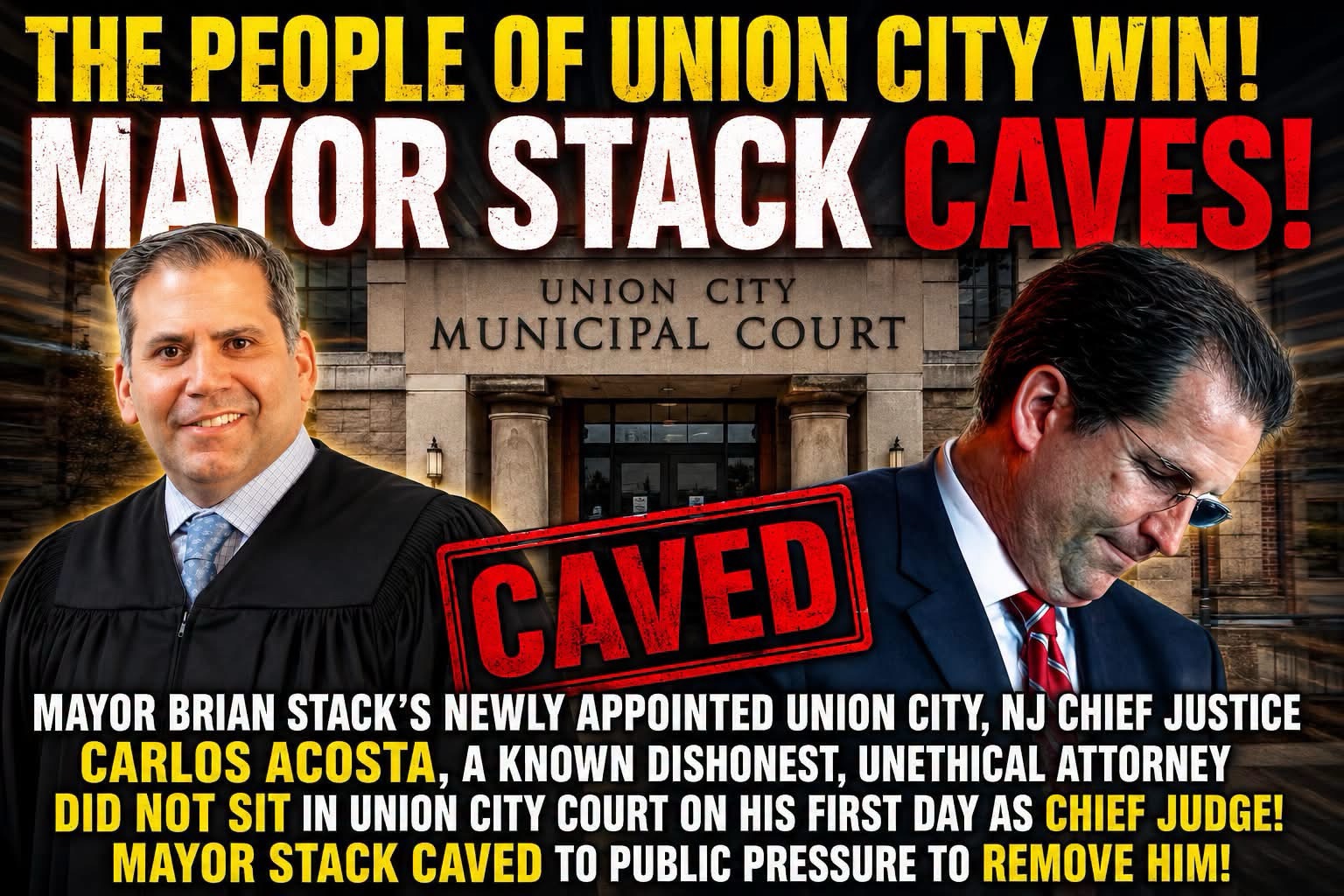
The decision to return Carlos Acosta to a position of judicial authority has once again raised serious questions about judgment, ethics, and public confidence in Union City’s government.
This is not about political parties or personalities. It is about the integrity of our courts.
The disciplinary history of Carlos Acosta is not a rumor or political talking point—it is a matter of public record. The Supreme Court of New Jersey suspended him from the practice of law after findings that included conduct involving dishonesty, fraud, deceit or misrepresentation, conduct prejudicial to the administration of justice, gross neglect, a pattern of neglect, lack of diligence, and failure to expedite legal matters. Those findings speak for themselves.
Judges are expected to meet the highest ethical standards because the public entrusts them with decisions affecting people’s liberty, property, and constitutional rights. When an attorney has previously been disciplined for misconduct of this nature, it is entirely reasonable for the public to question whether that individual should again serve on the bench.
Mayor Brian Stack also deserves scrutiny for his role in judicial appointments within Union City.
As both the Mayor of Union City and a New Jersey State Senator who serves as Chair of the Senate Judiciary Committee, Senator Stack occupies one of the most influential positions in New Jersey government regarding the judicial system. While the Senate Judiciary Committee does not appoint municipal judges, it plays a significant role in reviewing nominees to many judicial and prosecutorial positions throughout the State. That makes public confidence in his judgment especially important.
If reports are accurate that Carlos Acosta will not ultimately return as Union City’s Chief Municipal Judge after initially being selected, that decision raises an obvious question: what changed?
If concerns about public confidence or Acosta’s disciplinary history ultimately caused the appointment not to move forward, those concerns existed from the very beginning. They were matters of public record before any appointment was announced.
Public officials should exercise careful judgment before making appointments to positions of public trust. Judicial appointments should strengthen confidence in our courts—not create controversy that could have been avoided.
Citizens deserve transparency regarding how judicial candidates are evaluated. What standards are applied? How are prior disciplinary findings weighed? What assurances are given to the public that ethics and integrity remain the highest priorities?
These are fair questions, not political attacks.
The people of Union City deserve judges whose integrity is beyond question. The judiciary depends on public confidence, and that confidence is earned through accountability, transparency, and sound judgment.
Regardless of political affiliation, every resident should agree on one principle: our courts should never become the subject of avoidable controversy because of appointments that undermine public trust.
Our justice system functions best when the public believes those who sit in judgment have demonstrated the highest ethical character. That standard should never be compromised.
Discover more from HUDTRUTH
Subscribe to get the latest posts sent to your email.
Breaking News
Leaving the Badge Behind: Officers Report Hostile Political Workplace, Seek New Futures in the Military

The Hudson County Sheriff’s Office exists to protect the public, maintain courthouse security, and support law enforcement operations throughout the county. But when reports begin circulating of low morale, officer resignations, complaints of political retaliation, drastic overtime reductions, and wages that officers describe as unsustainable, county leadership should be paying attention.
According to numerous accounts shared by current and former sheriff’s officers, the Hudson County Sheriff’s Office is experiencing a troubling period under the leadership of Sheriff James “Jimmy” Davis and the administration of County Executive Craig Guy. The consistency of the concerns being raised should not simply be dismissed.
Perhaps most alarming are reports that some officers have chosen to leave law enforcement altogether or have enlisted in the United States military as a means of escaping what they describe as a politically hostile work environment. If true, that should concern every taxpayer in Hudson County.
Law enforcement agencies across the country face recruitment and retention challenges. Experienced officers are difficult to replace. When trained personnel voluntarily leave an agency in large numbers, it raises legitimate questions about workplace culture, leadership, compensation, and employee morale.
The concerns reportedly extend beyond pay. Officers have allegedly described a workplace where political favoritism, retaliation, and fear of speaking out have become commonplace. Whether those allegations ultimately prove true or not, perception matters. An agency cannot effectively serve the public when its own members believe they are not being treated fairly.
What makes the situation even more troubling is the contrast between campaign promises and current reports. During the 2025 sheriff’s race, supporters of Jimmy Davis argued that new leadership would restore morale, professionalism, and respect within the Sheriff’s Office. Public endorsements from law enforcement organizations praised Davis as someone who would support officers and improve working conditions. (New Jersey Globe)
Now, only months into the new administration, questions are reportedly being raised by officers who expected meaningful change. If morale is declining rather than improving, Hudson County residents deserve answers.
County Executive Craig Guy cannot escape scrutiny either. As the chief executive of county government, he ultimately oversees the administration responsible for funding and supporting county departments. If staffing shortages, retention problems, and employee dissatisfaction are becoming widespread, county leadership has a responsibility to investigate the causes and address them before the situation worsens.
The public should not view this solely as an employment issue. Every resignation represents the loss of experience, training, and institutional knowledge. Every vacancy places additional burdens on remaining officers. Every decline in morale has the potential to affect public service.
Hudson County residents deserve a Sheriff’s Office where officers want to stay, where employees feel valued, and where promotions, assignments, and opportunities are based on merit rather than politics.
If these reports are alleged through their PowerDMS systems where internal memos are published.
Either way, silence is not a solution.
The people of Hudson County deserve answers. More importantly, the men and women who wear the badge deserve leadership that earns their confidence, not leadership that drives them away.
Discover more from HUDTRUTH
Subscribe to get the latest posts sent to your email.
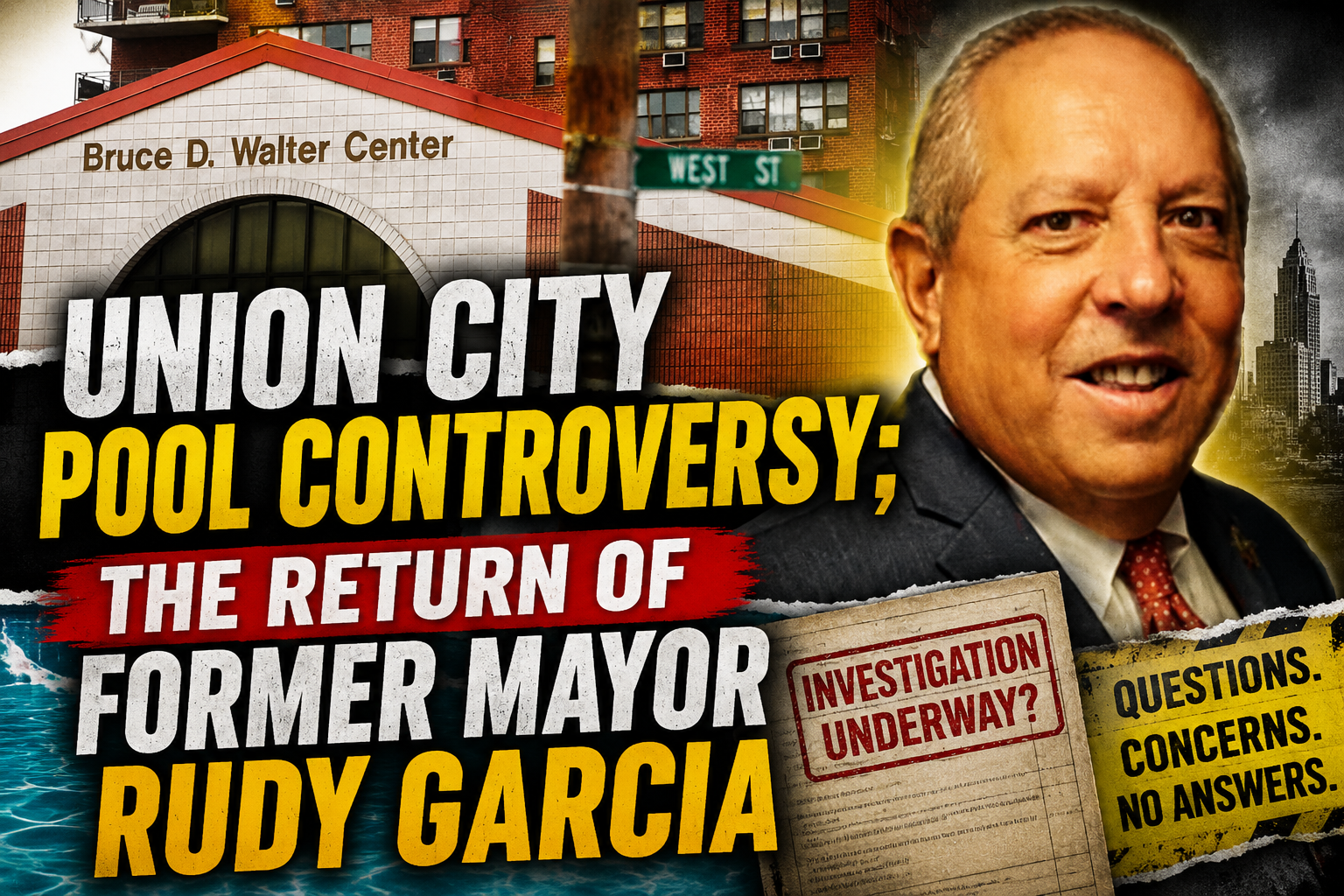
Something doesn’t add up.
The City says the Bruce D. Walter Pool passed inspection and received a satisfactory rating. At the same time, complaints were filed raising concerns about ventilation, humidity, water leaks, maintenance issues, and other conditions inside the building. An engineering review even recommended that some of those concerns receive further evaluation.
So who are residents supposed to believe?
What makes this situation even more frustrating is that many people feel like Union City is run by the same political insiders who always seem to end up on the same side, no matter how bitter their battles were in the past.
Brian Stack built his political career by taking on former Mayor Rudy Garcia. The fight between the two men helped reshape Union City politics and eventually led to Garcia leaving office and Stack becoming mayor.
Fast forward to today, and Rudy Garcia’s law firm, Dunkin & Dunkin LLC, is representing the City in this matter.
For residents watching from the outside, it’s hard not to notice the irony. The political enemies of yesterday now appear connected through City business while taxpayers are left asking questions about conditions inside a public facility.
Then there is Justin Mercado and the rest of the City’s leadership. Residents deserve to know who is responsible for making sure public buildings are properly maintained and why concerns raised by employees and members of the public continue to generate controversy.
Adding even more questions to the situation are anonymous reports that concerns about the facility have allegedly reached OSHA and PEOSH, the federal and state agencies responsible for workplace safety in public-sector / private workplaces. If employees feel the need to take their concerns outside City Hall, that should be a warning sign to City officials.
Whether those reports result in any formal action remains to be seen. But many residents are asking why workers and members of the public feel they have to go outside the City government in the first place.
The bigger issue is trust.
For years, Union City’s political establishment has told residents that everything is under control. Yet every time another controversy surfaces, the public is told not to worry, not to ask questions, and to simply trust the people in charge.
That approach is getting old.
If the facility is safe, release the reports.
If the concerns are unfounded, show the evidence.
If repairs are needed, explain the plan.
Residents should not have to rely on rumors, leaks, and political insiders to learn what is happening inside a public building paid for by taxpayers.
At the end of the day, this is about more than a pool.
It is about transparency, accountability, and whether the people running Union City are willing to answer tough questions instead of expecting the public to simply take their word for it.


Discover more from HUDTRUTH
Subscribe to get the latest posts sent to your email.


Controversial Judge Carlos Acosta; Wrong Choice for Union City Court.

Leaving the Badge Behind: Officers Report Hostile Political Workplace, Seek New Futures in the Military

Union City Pool Controversy; The Return of Former Mayor Rudy Garcia

Jimmy Davis Can’t Run From the Truth: The People Deserve to Know Who He Really Is

A Closer Look at Jamie Chebra: Former Jersey City EMS Leader’s Past and Present Under Scrutiny

BREAKING: Scandal Erupts Inside Hudson County Sheriff’s Office — Lt. Fedrow Found Guilty of Sexual Misconduct, County Officials Accused of Political Protection

-
 Breaking News10 months ago
Jimmy Davis Can’t Run From the Truth: The People Deserve to Know Who He Really Is
-
 Breaking News1 year ago
A Closer Look at Jamie Chebra: Former Jersey City EMS Leader’s Past and Present Under Scrutiny
-
 Breaking News9 months ago
BREAKING: Scandal Erupts Inside Hudson County Sheriff’s Office — Lt. Fedrow Found Guilty of Sexual Misconduct, County Officials Accused of Political Protection
-
 Breaking News1 year ago
UNION CITY POLICE OFFICER FERNANDO MURO IS FAMOUS!
-

 Breaking News1 year ago
A History Lesson of Corruption in Union City
-
 Breaking News1 year ago
🔥🚔 BREAKING: UNION CITY POLICE CHIEF ANTHONY FACCHINI IS A DISGRACE! OFFICERS WANT HIM GONE IMMEDIATELY! 🚔🔥
-
 Breaking News1 year ago
Republican Assembly Candidate Condemns Brian Stack Letter, Calls for Term Limits
-

 Breaking News1 year ago
📰 BREAKING: Barbara Pinzon Ousted in Union City Teachers Union Shake-Up – Juana Dominguez and Daniel Prusko Elected in Historic Shift Towards Transparency and Reform